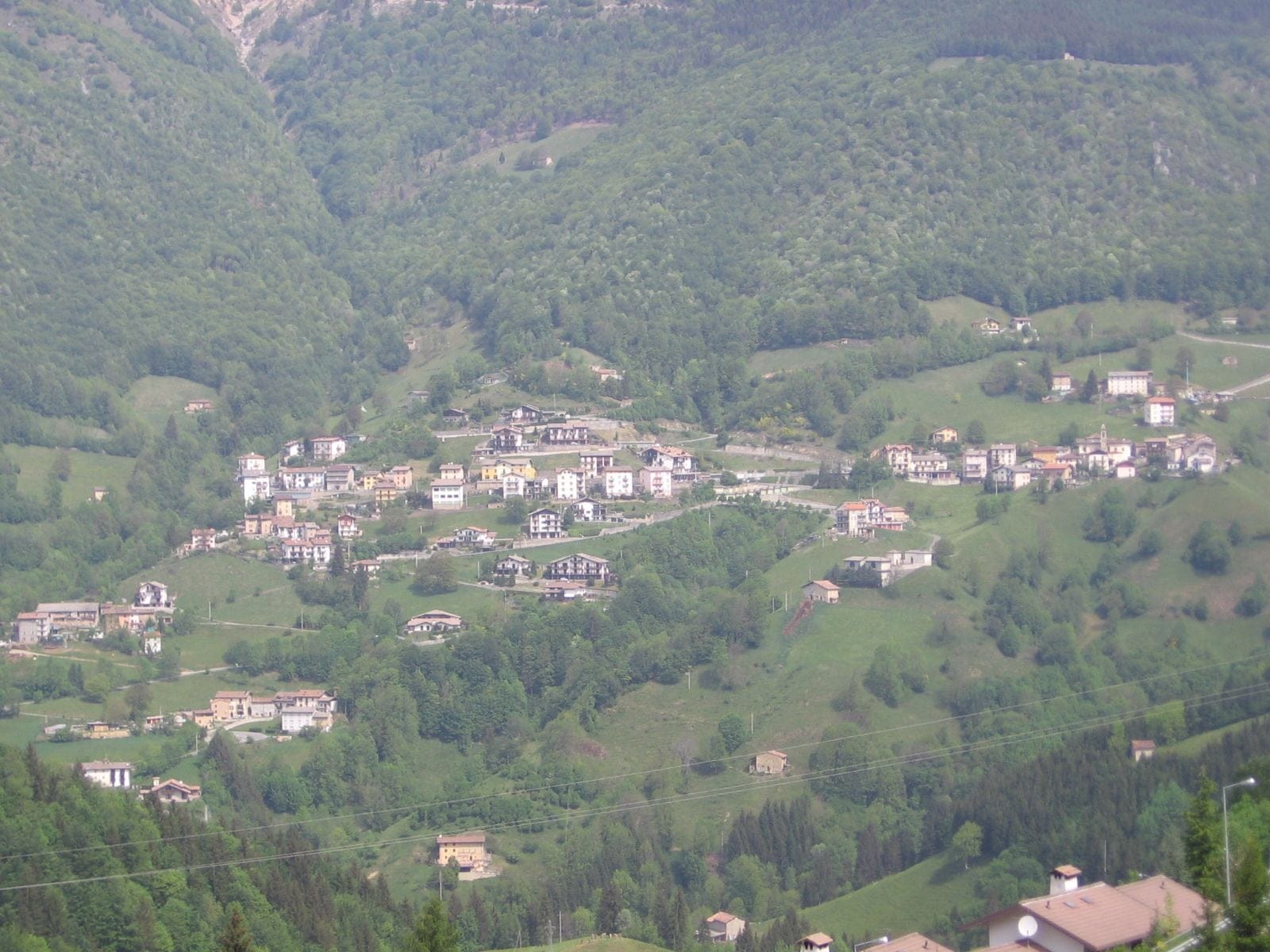
Church · Zorzone · Oltre il Colle
Church of the Santissima Trinità in Zorzone
Zorzone's parish church, a parish since 1636, rebuilt between 1745 and 1755 to a design by Giovan Battista Caniana: dome, stucco work and a canvas of 1628.
The church of the Santissima Trinità is the centre of Zorzone, a few hundred metres from the Museum of Minerals. It stands on a churchyard set lower than the road, paved in geometric patterns of porphyry and white stone, with a small one-bay porch in front of the entrance. The Centro Storico Culturale Valle Brembana describes it as a harmonious building with a tall two-storey façade, which keeps the forms of the original design outside and in.
Zorzone became a parish in 1636 and had a first church consecrated in 1644. What you see today is the rebuilding begun in 1745 to a design by Giovan Battista Caniana and completed in 1755, the year after the architect's death. Inside are the dome with the Assumption and the evangelists, the altars of Our Lady of the Rosary and of the Crucifix, the red marble baptistery and, in the sacristy, a Madonna della Cintura painted by Antonio Festi in 1628.
The history of the parish of Zorzone
On 24 September 1636 the bishop of Bergamo, Luigi Grimani, canonically erected the church of Zorzone as a parish; on 21 June 1644 it was consecrated by his suffragan bishop Giovan Battista Dovera, titular archbishop of Aleppo, with the title of the Holy Trinity. During the visit of bishop Gregorio Barbarigo, in the mid-seventeenth century, the parish belonged to the vicariate of Dossena, its patronage was held by the village community and it had a single priest.
The 1666 summary of churches calls it “mercenaria”, that is served by a curate paid by the villagers, and records the school of the Cintura and 173 parishioners. At the visit of bishop Giovanni Paolo Dolfin, between 1778 and 1781, there were three altars: the school of the Blessed Sacrament at the high altar and the confraternity of the Madonna della Cintura at the second; there were 185 parishioners and a chaplain assisted the curate. In 1861 the parish counted 260 parishioners, an oratory dedicated to Santa Maria and only the parish priest.
The eighteenth-century rebuilding to Caniana's design
By the mid-eighteenth century the seventeenth-century church was no longer large enough. Rebuilding began in 1745 to a design by Giovan Battista Caniana, born in Romano di Lombardia in 1671 and died in Alzano Lombardo in 1754, and according to the diocesan survey lasted until 1755. Bishop Dolfin consecrated the new church to the Holy Trinity in 1780. The new high altar arrived in 1795, paid for by the Palazzi family of the Sotaralli district, who held the patronage of the church.
It is a late eighteenth-century altar that the Centro Storico Culturale Valle Brembana describes as close to early neoclassicism, rich in coloured marbles and with a fine relief medallion on the frontal; the diocesan survey specifies that the round frontal depicts the Holy Trinity. In the choir hangs an eighteenth-century painting of the Trinity by an unknown artist.
What it looks like: façade, porch and interior
The porch in front of the entrance has a single cross-vaulted bay, carried by two pillars and open on three sides with tie-rodded arches, under a three-pitched roof. The two-pitched façade is divided into three sections by groups of pilasters ending in entablature, cornice and pediment; at the top, in the centre, a splayed window lights the nave, and below is the stone doorway.
The interior has a single nave divided into three bays by groups of pilasters with shafts in stucco imitating marble and Corinthian capitals. The first and third bays have barrel vaults with lunettes that make room for the windows; the second has a dome on pendentives resting on four great arches. In the centre of the dome a medallion shows the Madonna of the Assumption, others the virtues, and the pendentives hold the four evangelists. On the inner façade, above the draught lobby, a stucco frame encloses Jesus among the Doctors: the diocesan survey describes it as a fresco, Wikipedia as a canvas.
- First bay, left: the baptismal font in veined red marble under a small temple and, above it, the statue of St Roch between two cherubs
- First bay, right: the confessional and the statue of St Agnes in a niche
- Second bay: the chapels of Our Lady of the Rosary, with the statue of the Virgin and Child, and of the Holy Crucifix, with its painted altar frame and the statues of the Immaculate Virgin and St Barbara
- Third bay: the side entrance and the doors to the sacristy and bell tower
- Presbytery: raised by three steps, with a barrel vault, an apse with a half-dome and two painted wooden organ lofts with light gilding
Antonio Festi's Madonna della Cintura
The sacristy holds a Madonna della Cintura (Our Lady of the Girdle) painted by Antonio Festi in 1628, a few years before Zorzone became a parish. The Centro Storico Culturale Valle Brembana points it out for its style and lively composition: the Virgin offers the girdle to a group of saints, including Stephen, Anthony Abbot, a St Nicholas, a bishop saint and a female saint in a nun's habit.
The subject is no accident. The 1666 summary records in Zorzone the school of the Cintura, which looked after the altar of the Madonna della Cintura, and a century later bishop Dolfin found the confraternity of the same name: the canvas is a trace of a devotion that has accompanied the parish from its beginnings. The sacristy also keeps silver crosses, reliquaries, altar cards, lamps and vestments from the seventeenth century onwards.
The twentieth century: the 1911 evangelists, the bells and the new altar
In 1911 the painter Umberto Marigliani worked on the dome frescoes and the interior was repainted. The diocesan survey writes that Marigliani painted two of the evangelists on the pendentives, completing the existing decoration; Wikipedia credits him with the evangelists and other frescoes.
The present peal of five bells in A major was cast by the Crespi foundry of Cremona and consecrated by bishop Adriano Bernareggi on 3 March 1951, the same day as the bells of San Bartolomeo. In 1985, with the liturgical adaptation, the Comana firm made the altar facing the congregation and the ambo in grey, pink and yellow marble; on the front of the ambo is fixed a small angel's head in white marble, probably eighteenth-century.
San Rocco and the Beata Vergine del Miracolo: the small churches of Zorzone
The chapel of San Rocco stands on the old mule track from Oltre il Colle to Zorzone, just after it crosses the Parina stream, at the place called Mulino: the name recalls a mill driven by the stream's water. It was built in 1640 by the villagers in thanks for escaping the plague and completely rebuilt around the middle of the nineteenth century, when it had fallen into ruin, with a contribution from Stefano Scolari, who owned the land. On the small bell gable, with a bell dated 1898, a stone statue shows the saint; inside, a wooden statue of St Roch 80 centimetres tall shows him as a pilgrim, with hat, staff and the dog at his feet.
In an alpine setting at Peta stands the small church of the Beata Vergine del Miracolo, built in the eighteenth century and completed in 1784 according to the diocesan survey: a rustic façade with a sandstone doorway, a single barrel-vaulted nave and a small apse. The Wikipedia entry on Zorzone mentions a chapel at Peta dedicated to the Madonna della Gamba.
Visiting the church: contacts and information
The parish of the Santissima Trinità is at via Santissima Trinità 20; the directory of the diocese of Bergamo gives telephone 0345 95083 and email zorzone@diocesibg.it, but no mass times. The parish priest is the same as for San Bartolomeo and Zambla. The Holy Trinity is also the patron of the hamlet.
The church, the museum and the frescoes on the façades can be seen on the same walk, as they are all within a few hundred metres of each other.
In detail
Works and dates of the church
| Work or alteration | Artist or maker | Date | Source and notes |
|---|---|---|---|
| Madonna della Cintura, canvas in the sacristy | Antonio Festi | 1628 | Centro Storico Culturale Valle Brembana |
| Erection as a parish | Bishop Luigi Grimani | 24 September 1636 | Lombardia Beni Culturali |
| Consecration of the first church | Giovan Battista Dovera, suffragan bishop | 21 June 1644 | Lombardia Beni Culturali; BeWeB |
| Rebuilding of the church | Design by Giovan Battista Caniana (1671-1754) | 1745-1755 | BeWeB |
| Consecration to the Holy Trinity | Bishop Giovanni Paolo Dolfin | 1780 | BeWeB |
| High altar with Trinity frontal | Paid for by the Palazzi family of the Sotaralli district | 1795 | BeWeB |
| Holy Trinity, painting in the choir | Unknown | Eighteenth century | Centro Storico Culturale Valle Brembana |
| Evangelists on the dome pendentives | Umberto Marigliani | 1911 | Two evangelists according to BeWeB; the evangelists and other frescoes according to Wikipedia |
| Peal of five bells in A major | Crespi foundry of Cremona | 1951 | Consecrated on 3 March 1951 by bishop Adriano Bernareggi (BeWeB) |
| Altar facing the people and ambo in grey, pink and yellow marble | Comana firm | 1985 | BeWeB |
Practical tips
Before you set off
- Combine the church with the Museum of Minerals and the 23 frescoes on the village houses: everything is a few steps away.
- For the interior, aim for services or phone the parish (0345 95083): mass times are not published.
- The Madonna della Cintura is in the sacristy: ask the parish priest whether it can be seen.
- For a short walk, go down to the chapel of San Rocco, on the old mule track towards Oltre il Colle, just past the Parina stream.
FAQ
Frequently asked questions: Church of the Santissima Trinità in Zorzone
Who designed the church of Zorzone?
Giovan Battista Caniana (1671-1754). The rebuilding to his design began in 1745 and, according to the diocesan survey, ended in 1755, the year after his death; the new church was consecrated in 1780 by bishop Giovanni Paolo Dolfin.
Since when has Zorzone been a parish?
Since 24 September 1636, by decree of the bishop of Bergamo Luigi Grimani. The first church was consecrated on 21 June 1644 by the suffragan bishop Giovan Battista Dovera with the title of the Holy Trinity.
What is there to see inside the church of the Santissima Trinità?
A nave of three bays with faux-marble pilasters and Corinthian capitals, the dome with the Madonna of the Assumption and the four evangelists, the red marble baptistery with the statue of St Roch, the altars of Our Lady of the Rosary and the Holy Crucifix, the high altar of 1795 and, in the sacristy, Antonio Festi's Madonna della Cintura of 1628.
Who painted the evangelists in the dome at Zorzone?
Umberto Marigliani, in 1911. According to the diocesan survey he painted two of the four evangelists, completing an existing decoration; Wikipedia credits him with the evangelists and other frescoes.
What is the Madonna della Cintura of Zorzone?
It is a canvas by Antonio Festi dated 1628, kept in the sacristy: the Virgin offers the girdle to a group of saints. It recalls the devotion of the school and later the confraternity of the Cintura, recorded in Zorzone in 1666 and at the end of the eighteenth century.
Which other churches are there in Zorzone?
The chapel of San Rocco, built in 1640 to give thanks for the end of the plague on the mule track to Oltre il Colle, and the small church of the Beata Vergine del Miracolo at Peta, completed in 1784.
How do you contact the parish of Zorzone?
Via Santissima Trinità 20, telephone 0345 95083, email zorzone@diocesibg.it, according to the directory of the diocese of Bergamo, which does not publish mass times.
Sources
- Lombardia Beni Culturali, parrocchia della Santissima Trinità (sec. XVII - [1989]) · www.lombardiabeniculturali.it · accessed on 1 October 2026
- BeWeB, censimento della diocesi: Chiesa della Santissima Trinità · www.beweb.chiesacattolica.it · accessed on 1 October 2026
- BeWeB, Cappella di San Rocco (Zorzone) · www.beweb.chiesacattolica.it · accessed on 1 October 2026
- BeWeB, Chiesa della Beata Vergine del Miracolo (Peta) · www.beweb.chiesacattolica.it · accessed on 1 October 2026
- Diocesi di Bergamo, annuario: Zorzone SS. Trinità · diocesibg.it · accessed on 1 October 2026
- Centro Storico Culturale Valle Brembana, schede Oltre il Colle · culturabrembana.com · accessed on 1 October 2026
- Wikipedia, Chiesa della Santissima Trinità (Oltre il Colle) · it.wikipedia.org · accessed on 1 October 2026
- Wikipedia, Giovan Battista Caniana · it.wikipedia.org · accessed on 1 October 2026
- Wikipedia, Zorzone (patrona e cappella di Peta) · it.wikipedia.org · accessed on 1 October 2026
- Wikidata, chiesa della Santissima Trinità (Q105043905) · www.wikidata.org · accessed on 1 October 2026
- OpenStreetMap, chiesa della Santissima Trinità · www.openstreetmap.org · accessed on 1 October 2026
- OpenStreetMap, parcheggio vicino alla chiesa (mappa) · www.openstreetmap.org · accessed on 1 October 2026
Page verified on
Nearby
More pages from around here
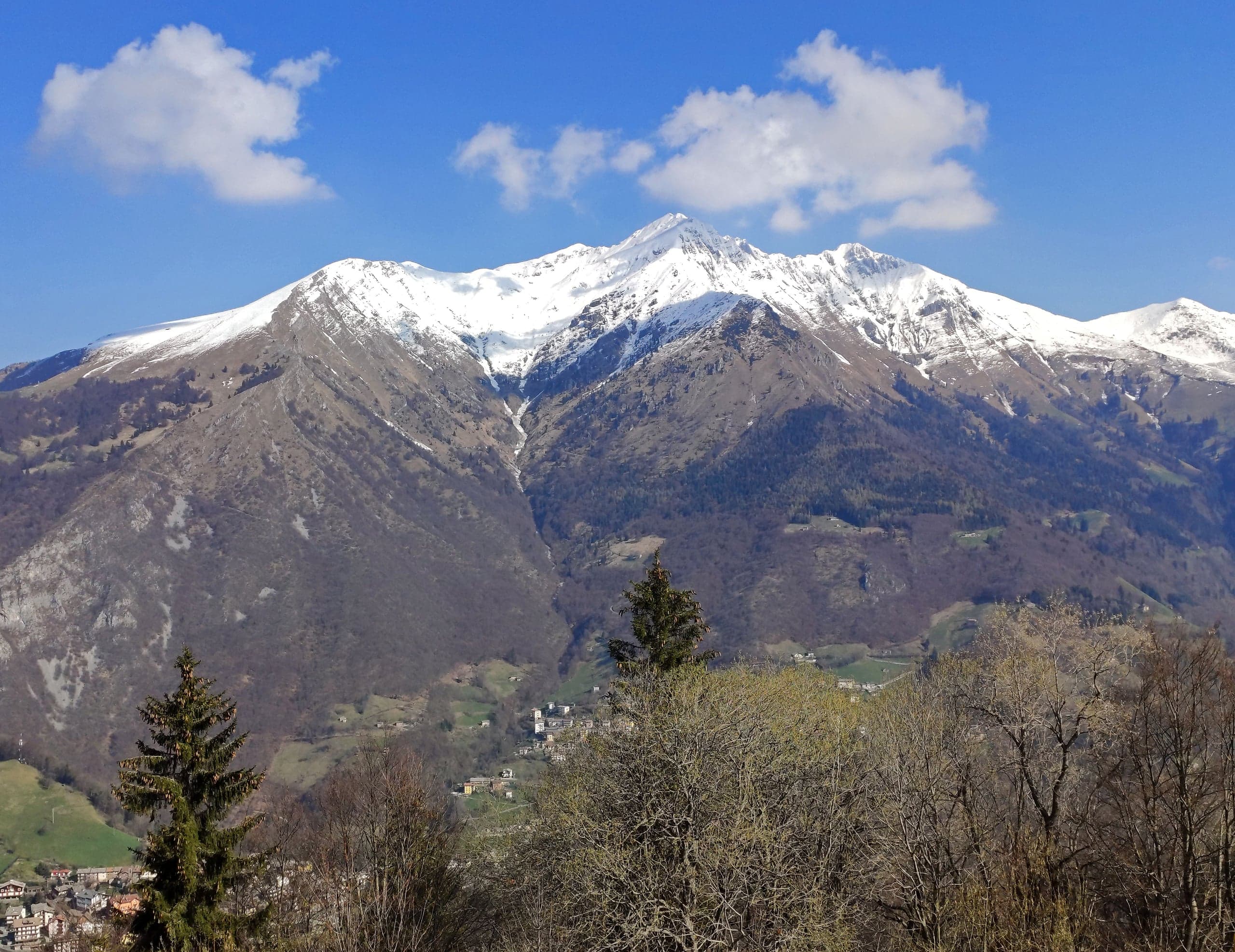
Summits · 2 minutes
Cima di Menna (2,300 m) from Zorzone
Cima di Menna, 2,300 m, from Zorzone on CAI trail 234: 1,250 m and 4 hours up through Val Carnera and the MAGA bivouac, with no water along the way.
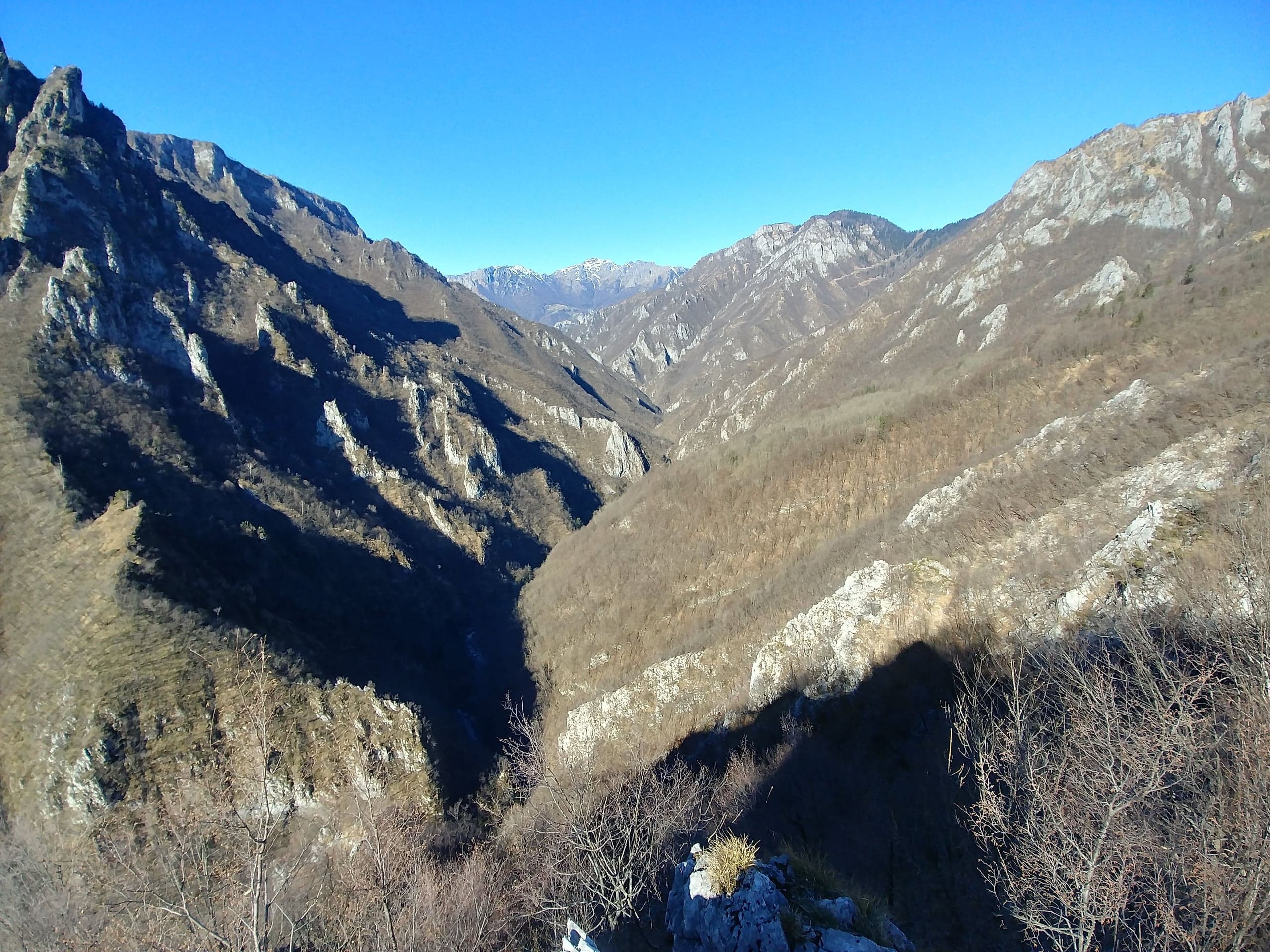
Hikes · 2 minutes
Val Parina: the traverse from Zorzone to Scalvino on CAI trail 259
Val Parina, Zorzone to Scalvino on CAI trail 259: 12 km and 450 m of descent through gorges, chained ledges and the rails of an old timber and marble line.
Museums · 2 minutes
Museum of Minerals and Mining in Zorzone
Three floors on the zinc and lead mines of Oltre il Colle in Zorzone's old school: miners' tools, a rebuilt tunnel, local minerals and a 1944 memorial.
Villages · 2 minutes
Zorzone, the mining village
Zorzone, at 1,019 metres, is the hamlet of the Val Vedra zinc mines: Caniana's church, the mining museum, 23 frescoes on the houses and the trails to the Menna.