Church · Oltre il Colle · Oltre il Colle
Parish church of San Bartolomeo
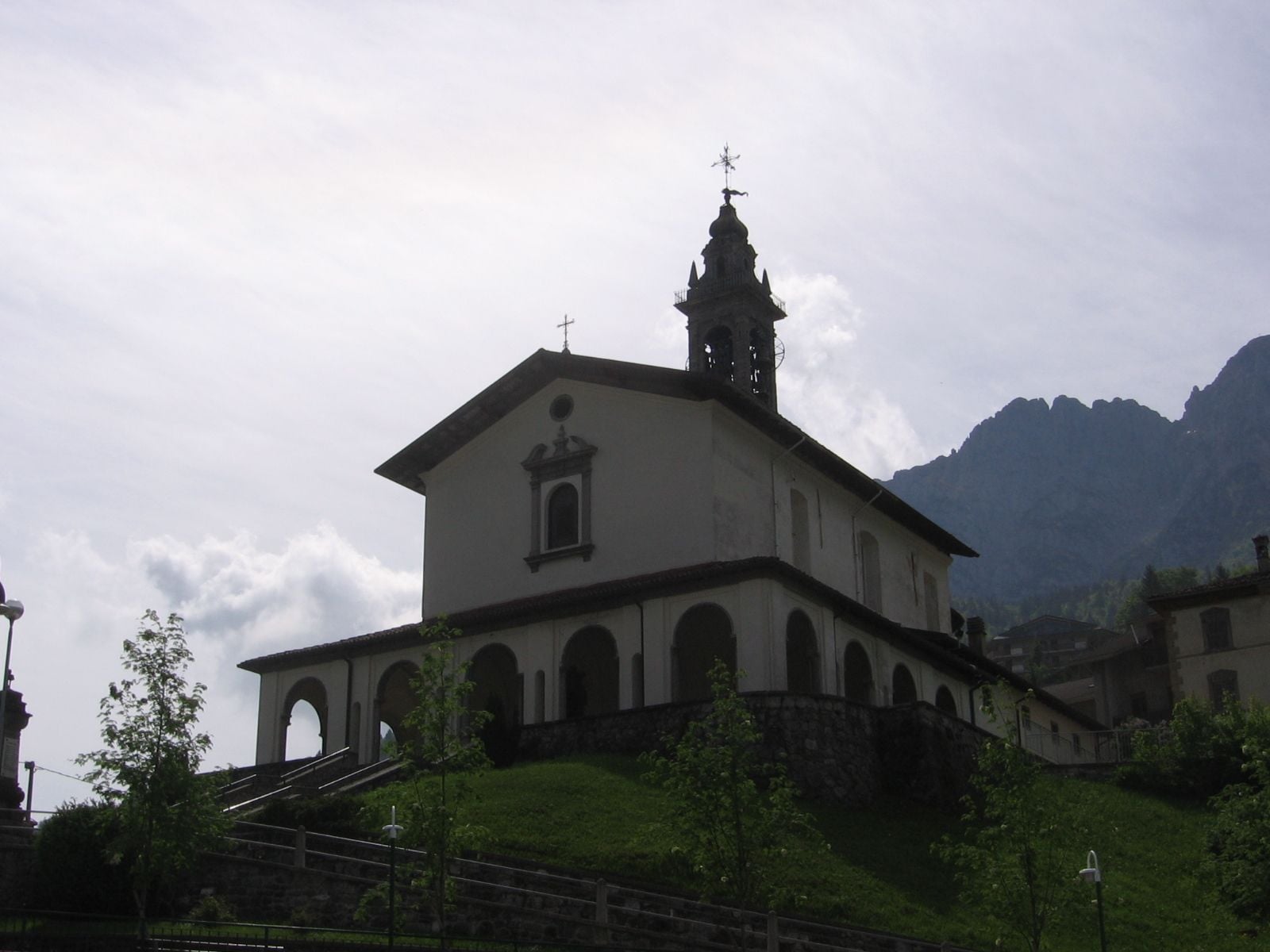
The parish church of Oltre il Colle, a parish since 1449: Luigi Angelini's three-sided portico (1935), frescoes by Orelli, a canvas by Scuri and a Bossi organ.
San Bartolomeo is the mother church of the basin: for more than a century it was the only parish in the whole area, until Zambla in 1587 and Zorzone in 1636 obtained their own. It stands above the main village, at the top of a wide flight of steps rising from the road to a stone-paved churchyard enclosed by a low wall of rough stones. The first thing you notice is the portico, which runs round three sides of the façade with large arches: it is the most visible sign of the enlargement designed in the 1930s by the Bergamo engineer and architect Luigi Angelini.
The building has an eighteenth-century character, with nineteenth- and twentieth-century alterations. Inside are the vault frescoes by Vincenzo Angelo Orelli from the early nineteenth century, including a Glory of St Dominic, the Death of St Joseph painted by Enrico Scuri in 1872, paintings by Francesco Coghetti and an organ by Carlo Bossi from the first years of the nineteenth century, which the Centro Storico Culturale Valle Brembana considers among the most intact and elegant known.
The chapel of Our Lady of Lourdes stands on the same churchyard; opposite the church, on the ground floor of a modern building, is the Domus Mariae chapel. Today San Bartolomeo is one of the three parishes of the municipality, all entrusted to the same parish priest, and belongs to Territorial Church Community 4, Valle Brembana, in the diocese of Bergamo.
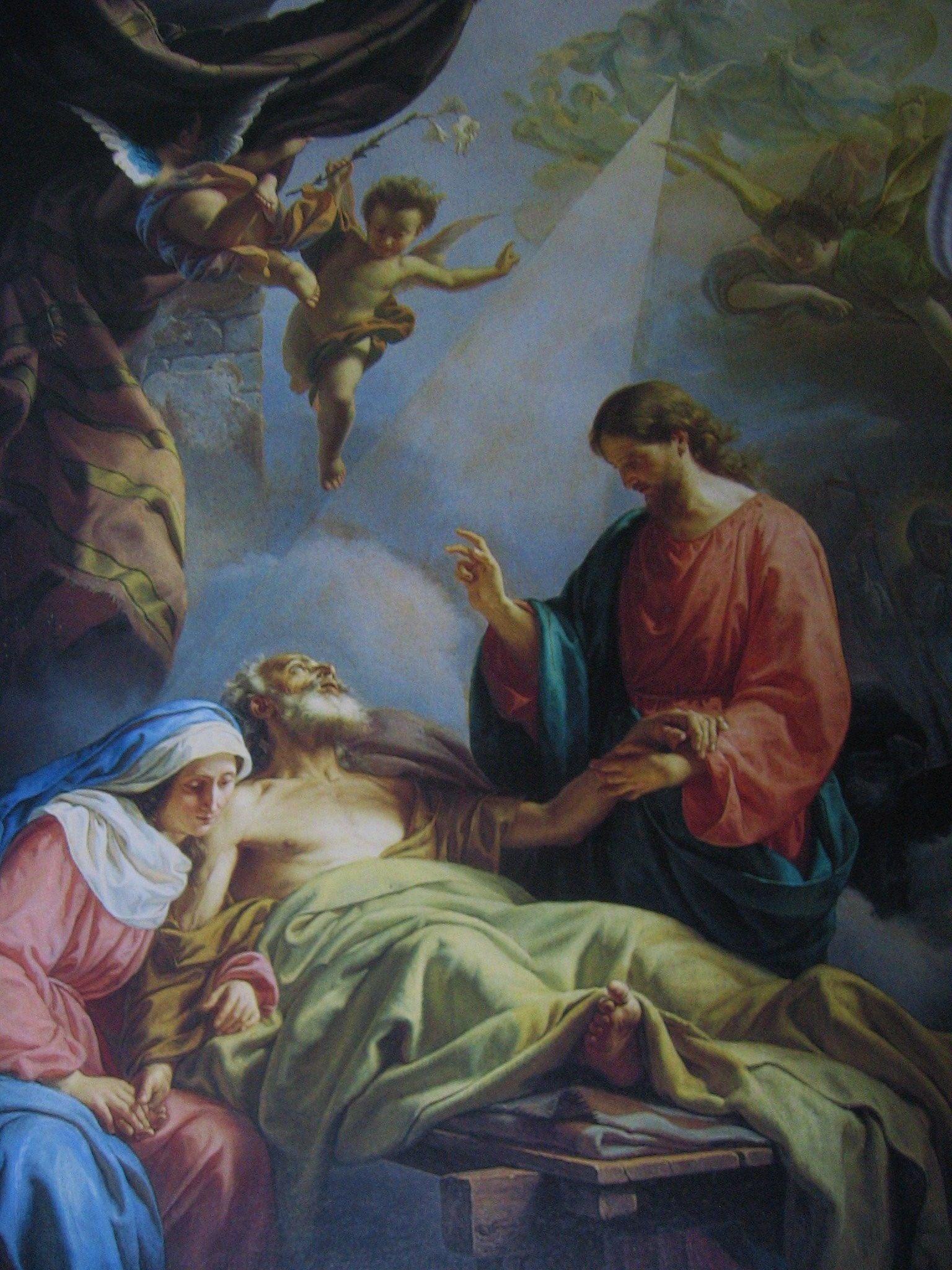
Photo: Ago76 (dipinto di Enrico Scuri, 1872) · CC BY-SA 3.0
The history of the church of San Bartolomeo
A church dedicated to the apostle Bartholomew already existed in the fifteenth century and in early times gave its name to the district. By a decree of 5 April 1449 the bishop of Bergamo, Polidoro Foscari, separated it from its mother church of San Giacomo di Lepreno and made it a parish: the deed was drawn up in Bergamo by the notary Giovanni Francesco Cavagnis of Cornalba, in the presence of the syndics and agents of the district of Grimoldo. When rural vicariates were created by the diocesan synod of 1568, the parish became part of the pieve of Dossena.
Pastoral visits allow us to follow it through the centuries. On 28 September 1575 the archbishop of Milan, Charles Borromeo, counted four altars and a community of about 500 souls, with the Misericordia confraternity and the school of Corpus Domini; the church's patronage belonged to the community. During the visit of bishop Gregorio Barbarigo, in the mid-seventeenth century, there were two priests and the confraternities of the Blessed Sacrament and of the Rosary. By the visit of bishop Giovanni Paolo Dolfin, between 1778 and 1781, there were five altars, the third dedicated to Our Lady of the Rosary, and the Misericordia was shared with the parishes of Zambla and Zorzone. Dolfin himself consecrated the church in 1780.
In the twentieth century the parish followed the diocese's reforms: in 1971 it joined pastoral zone V and from 27 May 1979 the local vicariate of Selvino-Serina. The diocesan directory now places it in Territorial Church Community 4, Valle Brembana, with the same parish priest as the parishes of Zambla and Zorzone.
From the 1803 restoration to Luigi Angelini's portico
The diocesan survey records a restoration of the stucco decoration and capitals in 1803, the same years in which Vincenzo Angelo Orelli was painting the vaults. In 1930 the bell tower was raised. In 1935 the church was restored and enlarged to a design by Luigi Angelini: this work, which the Centro Storico Culturale Valle Brembana dates between 1935 and 1937, gave the church the three-sided portico that wraps around the façade.
The last major change was the liturgical adaptation that followed the Second Vatican Council: an altar facing the congregation was placed in the middle of the presbytery, with a new ambo, both in pink marble and bronze by the sculptor Piero Cattaneo. The diocesan survey dates the work between 1975 and 1985; Wikipedia gives 1975 and names the architect Bruno Cassinelli as designer.
What it looks like: façade, portico and interior
The façade proper stands behind the portico, which is built in masonry, open in arches and covered by a timber roof with clay tiles. The doorway is in shaped stone, topped by the bishop's coat of arms; higher up a large arched window, set in a stone aedicule with pilasters and entablature, lights the nave and is crowned by a broken curved pediment. The roof has two pitches.
Inside there is a single nave on a rectangular plan, divided into six bays by fluted pilasters with Corinthian capitals carrying the entablature and cornice; the vault is a barrel vault. The presbytery, raised by three steps, is covered by a shallow dome, which the survey calls a “tazza”, a cup, and ends in an apsed choir with a half-dome. Bay by bay, the layout is as follows:
- First bay: two doors to the stairs leading up to the gallery
- Second bay: the confessionals
- Fourth bay: the altar of the Madonna on the left, the altar of the Crucifix on the right
- Fifth bay: the two side entrances
- Sixth bay: the door to the bell tower on the left and the door to the sacristy on the right
The works of art: Orelli, Scuri, Coghetti and Vavassori
The vaults were frescoed by Vincenzo Angelo Orelli (1751-1813), a painter born in Locarno who worked for a long time in the Bergamo area: the brightest scene, notes the Centro Storico Culturale Valle Brembana, is the Glory of St Dominic. In 1803 Orelli also painted two frescoes in the small church of Grimoldo, nearby.
The best-known canvas hangs in the atrium: the Death of St Joseph painted in 1872 by Enrico Scuri (1806-1884) of Bergamo, an intense work, neoclassical in its composition but with echoes of the eighteenth century, according to the same source. The church also holds paintings by Francesco Coghetti (1802-1875), mentioned by Wikipedia and L'Eco di Bergamo without their subjects, and on the Madonna's altar a wooden statue by Angelo Virgilio Vavassori (1885-1961).
The church's heritage also includes furnishings, chasubles, crosses, chalices and lace from the sixteenth to the eighteenth century, as well as twentieth-century paintings and sculptures of craft quality. The table below lists works, makers and dates with the source of each item.
The bell tower, the bells and the Bossi organ
The bells carry the marks of the wars. The diocesan survey records that the five bells blessed by bishop Pier Luigi Speranza in 1860 became eight when the bell tower was raised in 1930; after the wartime requisitions, the surviving bells were recast by the Crespi foundry into the present peal of eight bells in D major, consecrated by bishop Adriano Bernareggi on 3 March 1951. The Wikipedia entry on the municipality speaks instead of eight bells in B by the Capanni foundry: the two sources do not agree.
The organ is by Carlo Bossi. The Centro Storico Culturale Valle Brembana dates it to 1804 and describes it as one of the most intact and elegant known; Wikipedia gives 1805.
Grimoldo and the other churches of the parish
Grimoldo is the oldest name in the basin: at the end of the thirteenth century it was the main community, and in 1449 it was the representatives of the Grimoldo district who attended the founding of the parish. Here, at the top of a flight of steps, stands the small church of Santa Maria Nascente, which bishop Dolfin recorded as the oratory of the Nativity of the Virgin. According to the Centro Storico Culturale Valle Brembana it was built, with later rebuilding, on a medieval chapel dedicated to the Holy Cross and the Nativity of Mary; the façade has eighteenth-century frescoes, the interior eighteenth-century stucco and two frescoes by Vincenzo Angelo Orelli dated 1803. The diocesan survey also records two paintings of the Presentation of Jesus in the Temple and the Adoration of the Magi.
On the parish churchyard is the chapel of Our Lady of Lourdes: three arches on stone columns lead into a single room with votive offerings on the walls and, at the back, the statues of the Virgin and Bernadette on a base of tufa. The original chapel dates from the seventeenth century and a gravestone of 1761 recalls the dead buried there. Opposite the church, on the ground floor of a reinforced-concrete building, is the Domus Mariae chapel, a simple room with a crucifix on the end wall.
Visiting the church: contacts, mass times and the feast of St Bartholomew
The directory of the diocese of Bergamo gives the parish address as via Roma 171, telephone 0345 95095, email oltreilcolle@diocesibg.it, but publishes no mass times for the churches of Oltre il Colle. There are no fixed opening hours: the church is usually visited before or after services, or by asking at the parish.
St Bartholomew is the patron saint of the municipality and his feast falls on 24 August. The three parish churches of the basin, here in the main village, in Zambla Bassa and in Zorzone, can be seen in the same morning.
In detail
Documented works and alterations
| Work or alteration | Artist or maker | Date | Source and notes |
|---|---|---|---|
| Vault frescoes, including the Glory of St Dominic | Vincenzo Angelo Orelli (1751-1813) | Early nineteenth century | Centro Storico Culturale Valle Brembana |
| Restoration of the stucco decoration and capitals | Not given | 1803 | Diocesan survey (BeWeB) |
| Organ | Carlo Bossi | 1804 | Centro Storico Culturale Valle Brembana; Wikipedia gives 1805 |
| Death of St Joseph, canvas | Enrico Scuri (1806-1884) | 1872 | In the atrium, according to the Centro Storico Culturale |
| Paintings | Francesco Coghetti (1802-1875) | Not given | Mentioned by Wikipedia and L'Eco di Bergamo without titles |
| Wooden statue of the Madonna | Angelo Virgilio Vavassori (1885-1961) | Not given | On the Madonna's altar, according to Wikipedia |
| Raising of the bell tower | Not given | 1930 | Diocesan survey (BeWeB) |
| Restoration, enlargement and three-sided portico | Luigi Angelini, engineer and architect | 1935 | BeWeB; 1935-1937 according to the Centro Storico Culturale |
| Peal of eight bells in D major | Crespi foundry | 1951 | Consecrated on 3 March 1951 (BeWeB); Wikipedia attributes it to the Capanni foundry |
| Altar facing the people and ambo in pink marble and bronze | Piero Cattaneo, sculptor | 1975-1985 | BeWeB; Wikipedia gives 1975 and a design by the architect Bruno Cassinelli |
Where the maker or date is not given, the sources consulted do not state it.
Practical tips
Before you set off
- To see the interior, aim for service times or phone the parish (0345 95095): the diocese does not publish mass times.
- Enrico Scuri's Death of St Joseph is in the atrium, by the entrance: it is the first work to look for.
- Go up to Grimoldo too, to the small church of Santa Maria Nascente: its eighteenth-century painted façade can be seen even when the church is closed.
- 24 August, the patron's feast, is the day the church is at its liveliest.
- On the churchyard, look into the chapel of Our Lady of Lourdes, with its votive offerings on the walls.
FAQ
Frequently asked questions: Parish church of San Bartolomeo
Since when has San Bartolomeo been the parish of Oltre il Colle?
Since 1449: by a decree of 5 April that year the bishop of Bergamo, Polidoro Foscari, separated it from the church of San Giacomo di Lepreno. The church was consecrated in 1780 by bishop Giovanni Paolo Dolfin and enlarged in 1935 to a design by Luigi Angelini.
Who designed the portico of the church in Oltre il Colle?
The Bergamo engineer and architect Luigi Angelini, who in 1935 directed the restoration and enlargement of the church; the Centro Storico Culturale Valle Brembana dates the work between 1935 and 1937. The portico runs round three sides of the façade.
Which works of art are in the parish church of San Bartolomeo?
The vault frescoes by Vincenzo Angelo Orelli from the early nineteenth century, including the Glory of St Dominic; Enrico Scuri's Death of St Joseph of 1872; paintings by Francesco Coghetti; a wooden statue of the Madonna by Angelo Virgilio Vavassori and the organ by Carlo Bossi, of 1804 or 1805 depending on the source.
When is the feast of St Bartholomew in Oltre il Colle?
On 24 August. St Bartholomew the Apostle is the patron saint of the municipality of Oltre il Colle and titular saint of the main village's parish church.
Where can you find mass times in Oltre il Colle?
The directory of the diocese of Bergamo does not publish them for the churches of the basin. The parish of San Bartolomeo is at via Roma 171: telephone 0345 95095, email oltreilcolle@diocesibg.it. The municipality's three parishes have the same parish priest.
How many bells does the church of San Bartolomeo have?
Eight. The diocesan survey attributes them to the Crespi foundry, which after the war recast the bells that had escaped requisition into a peal in D major consecrated on 3 March 1951; the Wikipedia entry on the municipality speaks instead of a peal in B by the Capanni foundry.
What is the small church of Grimoldo?
It is the church of Santa Maria Nascente, in the Grimoldo district, a chapel of ease of the parish of San Bartolomeo. Its façade was painted in the eighteenth century and inside are two frescoes by Vincenzo Angelo Orelli of 1803; according to the Centro Storico Culturale Valle Brembana it stands on a medieval chapel of the Holy Cross and the Nativity of Mary.
Sources
- Lombardia Beni Culturali, parrocchia di San Bartolomeo apostolo (sec. XV - [1989]) · www.lombardiabeniculturali.it · accessed on 1 October 2026
- Lombardia Beni Culturali, Comune di Oltre il Colle (soggetto produttore, sec. XIII - ) · www.lombardiabeniculturali.it · accessed on 1 October 2026
- BeWeB, censimento della diocesi: Chiesa di San Bartolomeo · www.beweb.chiesacattolica.it · accessed on 1 October 2026
- BeWeB, Chiesa di Santa Maria Nascente (Grimoldo) · www.beweb.chiesacattolica.it · accessed on 1 October 2026
- BeWeB, Cappella della Madonna di Lourdes · www.beweb.chiesacattolica.it · accessed on 1 October 2026
- BeWeB, Cappella Domus Mariae · www.beweb.chiesacattolica.it · accessed on 1 October 2026
- Diocesi di Bergamo, annuario: Oltre il Colle S. Bartolomeo apostolo · diocesibg.it · accessed on 1 October 2026
- Centro Storico Culturale Valle Brembana, schede Oltre il Colle · culturabrembana.com · accessed on 1 October 2026
- Wikipedia, Chiesa di San Bartolomeo (Oltre il Colle) · it.wikipedia.org · accessed on 1 October 2026
- Wikipedia, Oltre il Colle (campane, organo, patrono) · it.wikipedia.org · accessed on 1 October 2026
- Wikidata, chiesa di San Bartolomeo (Q105004008) · www.wikidata.org · accessed on 1 October 2026
- OpenStreetMap, chiesa parrocchiale di San Bartolomeo apostolo · www.openstreetmap.org · accessed on 1 October 2026
- L'Eco di Bergamo (2008), ripreso da Valle Brembana News: «Oltre il Colle» (copia d'archivio) · web.archive.org · accessed on 1 October 2026
- Wikipedia, Vincenzo Angelo Orelli · it.wikipedia.org · accessed on 1 October 2026
- Wikipedia, Enrico Scuri · it.wikipedia.org · accessed on 1 October 2026
- Wikipedia, Francesco Coghetti · it.wikipedia.org · accessed on 1 October 2026
- Wikipedia, Angelo Virgilio Vavassori · it.wikipedia.org · accessed on 1 October 2026
- OpenStreetMap, parcheggio accanto alla chiesa (mappa) · www.openstreetmap.org · accessed on 1 October 2026
Page verified on
Nearby
More pages from around here
Mountain huts · 2 minutes
Bivouacs and shelters on the Grem, the Alben and the Menna
Bivouacs around Oltre il Colle: Mistri and Telini on the Grem, Baita Nembrini and Gioan on the Alben, MAGA below the Menna. Who runs them, beds, what's open.
Cycling and MTB · 2 minutes
Mountain biking in Oltre il Colle
Mountain biking in Oltre il Colle: the 29.4 km loop via the Capanna 2000 and the Val Vedra, the Val Parina, the Val del Riso, the Arera Tour and e-bike hire.
With children · 2 minutes
Playgrounds and picnic areas in Oltre il Colle
Playgrounds and picnic areas in Oltre il Colle: the via Roma municipal park, the inclusive park at Zambla Alta, and the grills at the Colle di Zambla and the Conca.
Hikes · 2 minutes
Sentiero dei Fiori “Claudio Brissoni”
Sentiero dei Fiori Claudio Brissoni: a CAI loop of about 3 hours from the Capanna 2000 to Passo Branchino, 1,821–2,078 m, on the flowering slopes of the Arera.