Village · Zorzone · Oltre il Colle
Zorzone, the mining village
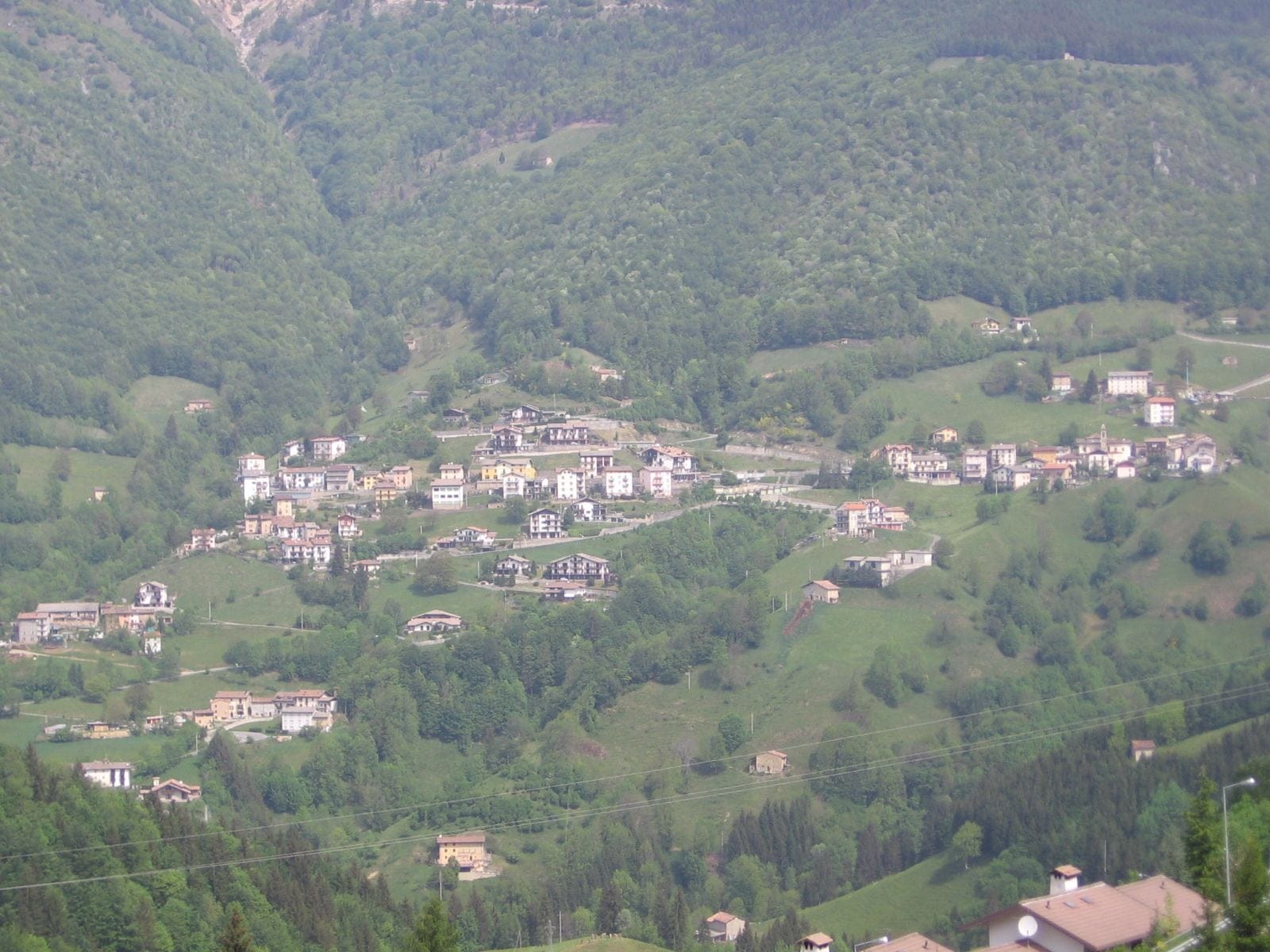
Zorzone, at 1,019 metres, is the hamlet of the Val Vedra zinc mines: Caniana's church, the mining museum, 23 frescoes on the houses and the trails to the Menna.
Zorzone, Zùrzù in dialect, is the hamlet of Oltre il Colle most closely tied to the mines. It lies at about a thousand metres, 1,019 according to the CAI, at the foot of the Cima di Menna, across the Parina stream from the main village. Above the houses opens the Val Vedra, with the place called Pian Bracca, where zinc and lead were dug for decades; along the stream, at Cà Pasì, were adits and outside works of the mine.
Today the village is explored on foot: the church of the Santissima Trinità designed by Giovan Battista Caniana, the Museum of Minerals and Mining in the former school, 23 frescoes on the house fronts and, just outside, the small churches of San Rocco and of the Beata Vergine del Miracolo. CAI trails to the Val Vedra and Monte Menna start here. The sources disagree on the number of inhabitants: Wikipedia gives about 220, a 2026 article on Valbrembanaweb speaks of just over a hundred.
The mining story is not quite over: in 2015 drilling found a new orebody beneath the village and in February 2026 the ministry authorised exploration to resume. For now it is only exploration, as explained below.
The name and the history of the village
On the origin of the name, Wikipedia reports as the most widely accepted theory that it comes from the Zorzi, one of the leading local families, and considers a link with the painter Giorgione less likely. In the sixteenth century Zorzone was one of the five “colonnelli”, the districts into which the municipality was divided, according to one of the Lombardia Beni Culturali archive records; with the reform of the town council in 1779 it elected two of the ten councillors. In 1636 it became a parish and in April 1797, under the Bergamo Republic, it even made itself an independent municipality, reabsorbed by Oltre il Colle as early as March 1798.
The municipal archive keeps the papers of two bequests to the people of the parish, which say a good deal about village life. The Marietti bequest came from the will of 10 November 1770 of Giovanni Antonio Palazzi, known as Marietto, who left meadows and a house to the villagers of Zorzone for charity; the Castellini bequest from the wills of Antonio Castellini (1801) and his niece Lucia (1803). In 1930, at the villagers' request, a plot belonging to the Castellini bequest was given for a nursery school, built with the help of the whole village and the parish; from 1953 the bequest's income went to the nursery, which in 1963 passed to the parish of the Santissima Trinità.
The mines above Zorzone: Val Vedra, Pian Bracca and Cà Pasì
The mines of Oltre il Colle were divided into three areas: the first above Zorzone, at Pian Bracca, where the Val Vedra mine opened; the second on the Arera, where from the nineteenth century there was also an open-cast working called “Luna”; the third along the Val Parina and on the slopes of Monte Plassa. Mainly calamine, blende and galena were extracted, yielding zinc, lead and a little silver.
The mining drawings in the Gorno Mines archive preserve the names of the Val Vedra workings, Pian Bracca, Malanotte, Piazzole, Forcella, Ponente, Speranza, Bellavista and Fortuna, and record a “Vedra concession” as early as the first decades of the twentieth century. A 2020 geological study confirms that the Val Vedra mine, between the Menna and the valley, was partly worked in the 1970s, on levels between 940 and 1,070 metres; lower down ran the Riso-Parina tunnel, which linked the Val del Riso to the Val Parina.
The 1970s were the last season of investment. The archive holds the drawing of the entrance of the “ribasso Zorzone” adit (April 1971), the projects for a cableway at Cà Pasì (1970-1971), the building of a mining road at Case Pasini by the Rottigni company (1975), a 1979 study on ventilation between the Riso-Parina level and the Val Vedra and, as late as March to August 1980, a plan of the new outside works planned at Cà Pasì. Less than two years later the mines closed.
Who ran the mines and why they closed
The sequence of companies, summarised in the table, can be reconstructed from the profiles in the Gorno Mines archive published by Lombardia Archivi: from 1870 the English firms Richardson and then Crown Spelter, then the Belgians of Vieille Montagne, who from the end of the nineteenth century held the concessions of Zambla, Monte Arera, Oltre il Colle and the Val Vedra and in 1922 also took over those of Crown Spelter.
In 1940 the Italian government expropriated Vieille Montagne and the concessions passed to state-owned companies. From 3 January 1942 SAPEZ, Società anonima piombo e zinco, owned the sites of Gorno, Oneta and Oltre il Colle, with 350 workers on shifts covering 24 hours. During the German occupation production came under the control of the Reich, and the mines also became a refuge: according to the testimonies collected by the Blog della Valserina many men hiding in the mountains of the valley found work in the SAPEZ mines. In 1954 SAPEZ was absorbed into AMMI, which at the end of 1978 merged into SAMIM, part of the Eni group.
SAMIM was the last concession holder: in 1982 it gave up the concession of the Val del Riso mines and ended extraction. The Gorno Ecomuseum dates the end to 12 January 1982, the Zorzone museum says 1980 and a 2020 geological study places the last underground work up to 1985. On the causes the sources stress prices: competition from countries able to sell zinc more cheaply, wrote Prima Bergamo in 2019, while in 2015 L'Eco di Bergamo pointed out that the mines had not closed for lack of ore.
The return of zinc: exploration today
The closed mines remained under concession. In 2014 the Australian company Energia Minerals obtained permits to resume work across Oltre il Colle, Gorno, Oneta, Premolo and Ardesio, and in 2015 it opened a site at Cà Pasì, with mining announced for the end of 2017 according to L'Eco di Bergamo. Mining never started, but the drilling found something.
In 2015, writes the study published in Mineralium Deposita, a drilling campaign from the old Val Vedra workings located, a few hundred metres beneath the village, the orebody called “Zorzone”: according to the company's declared estimates, 3.3 million tonnes of sulphides grading 4.9 per cent zinc, 1.3 per cent lead and 27.2 grams of silver per tonne. In 2025 the ministry suspended exploration because of some drilling outside the approved plan, reported by the company itself; in February 2026 it approved the environmental impact assessment after the fact, with conditions including consultation with Arpa and Uniacque and environmental monitoring.
The company Vedra, which has worked on the project since 2012, stated in May 2026 that it had spent about 16 million euros in fifteen years, that its mining plan was 90 per cent ready and that it could create up to 250 jobs; to get there, however, it needs a mining permit and investors.
The village of frescoes
Zorzone is also known as the village of frescoes. The idea came in 2006 from the then mayor Rosanna Manenti, who wanted to make the hamlet the “borgo degli affreschi”: between 2006 and 2009 three editions of a competition brought scenes from local history and the life of the past onto the house fronts.
After about twenty years the competition returned on 29 August 2026 with ValParinART, promoted by the Oltre il Colle library. Eight students from the “Giacomo e Pio Manzù” art high school in Bergamo, led by the teacher and painter Giovanni Bonaldi, painted seven new frescoes on the theme “C'era una volta”, once upon a time: among them “La funivia”, “Bat la ranza”, “Fà la fòia” and “Ol pustì” by Arianna Cortesi, which won the competition. With these works the village's frescoes now number 23, and on the same day the artist Frode painted the mural “Memorie di luce” on the museum façade.
A cable car between Oltre il Colle and Zorzone really did exist: a photograph dated 1958 in L'Eco di Bergamo's Storylab photo archive shows it, and the caption notes that it was dismantled when the hamlet could be reached by a convenient road. The museum, after all, stands on via Funivia, cable car street.
What to see in Zorzone: a walk round the village
The walk is done on foot, starting from the car parks near the church. The stops:
- The church of the Santissima Trinità by Giovan Battista Caniana, with the Madonna della Cintura of 1628 in the sacristy
- The Museum of Minerals and Mining, on via Funivia, with the “Memorie di luce” mural on the façade
- The 23 frescoes on the houses, from the 2006-2009 editions to the seven new ones of 2026
- The chapel of San Rocco of 1640, on the old mule track to Oltre il Colle just past the Parina stream
- The small church of the Beata Vergine del Miracolo at Peta, completed in 1784
- Pian Bracca, reachable by car, at the mouth of the Val Vedra, where the main mine was
Trails from Zorzone: the Val Vedra and Monte Menna
CAI trail 231 starts in Zorzone, on via Giorgi, and follows the mule track that enters the Val Vedra along the hillside; it climbs the valley to Pian Bracca, the Pessel hut and the pastures of the Vedro dairy hut, then reaches the Passo di Val Vedra, at 1,848 metres, and ends at Passo Branchino, at 1,821, where it meets the trails to the Capanna 2000, the Alpe Corte hut and the Mezzeno huts.
CAI 234 starts instead from via Colombi and climbs north through the woods of the Val Carnera, passes the Mattuida farmhouse at 1,470 metres and with a final steep pull reaches the MAGA bivouac, at 2,005 metres, now the Rifugio Palazzi, then the ridge and the summit of Monte Menna, at 2,299 metres. On the Menna, just below the ridge at Pezzadello, the American bomber Lady Irene crashed on 4 October 1944; the museum's memorial recalls it. The technical data for both trails are in the table.
In detail
The companies that ran the mines
| Period | Company | What it did here |
|---|---|---|
| 1870-1883 | Richardson & Co., London | Takes over concessions from the Sileoni firm around Gorno and the sites of Costa Jels and Grina-Golla-Splazzi, partly in the municipality of Oltre il Colle |
| 1883-1922 | The English Crown Spelter Company | From 1884 also leases the Monte Arera and Zambla mines; in 1922 hands its concessions to Vieille Montagne |
| 1888-1940 | Vieille Montagne, Liège | Acquires the concessions of Zambla, Monte Arera, Oltre il Colle and Val Vedra; from 1922 divides the deposits into a Seriana valley group and a Brembana valley group |
| 1940-1942 | AMMI and Società anonima nichelio e metalli nobili | Expropriation of Vieille Montagne; in 1941 the concessions pass to the AMMI group company |
| 1942-1954 | SAPEZ, Società anonima piombo e zinco | Owner of the Gorno, Oneta and Oltre il Colle sites, with 350 workers on shifts covering 24 hours |
| 1954-1978 | AMMI | Absorbs SAPEZ; in the 1970s works and projects in the Val Vedra and at Cà Pasì |
| 1978-1982 | SAMIM, Eni group | Last concession holder: in 1982 gives up the concession and ends mining |
Source: company profiles in the Gorno Mines archive, Lombardia Archivi (Lombardy Region). Wikipedia reconstructs the sequence differently.
CAI trails starting from Zorzone
| Trail | Destination | Grade | Ascent | Length | Time up |
|---|---|---|---|---|---|
| CAI 231 | Pian Bracca, Val Vedra, Passo Branchino (1,821 m) | E | about 850 m | about 7.6 km | 3 hours |
| CAI 234 | MAGA bivouac, Monte Menna (2,299 m) | E | about 1,250 m | about 4.8 km | 4 hours |
Data from the CAI Bergamo geoportal; return in 2 hours 10 minutes on the 231 and 2 hours 15 minutes on the 234. Recommended season: April to October.
Practical tips
Before you set off
- Zorzone is visited on foot: the church, the museum and the frescoes are a few hundred metres from each other.
- The museum opens mainly on Sunday and holiday afternoons: phone 0345 95313 before you go.
- The adits of the old tunnels are in mining areas under concession and cannot be visited: do not go in.
- For the Val Vedra and the Menna you need boots: trails 231 and 234 are hiking trails and the CAI recommends them from April to October.
- Look out for the new frescoes of 2026, such as “Ol pustì”, the winner, and “La funivia”.
FAQ
Frequently asked questions: Zorzone, the mining village
How many people live in Zorzone?
Estimates differ: Wikipedia gives about 220 inhabitants, while a September 2026 article on Valbrembanaweb speaks of just over a hundred residents. It is one of the three hamlets of Oltre il Colle, with Zambla Alta and Zambla Bassa.
Where does the name Zorzone come from?
The most widely accepted theory, according to Wikipedia, derives it from the Zorzi, one of the leading local families; a link with the painter Giorgione is less likely. In Bergamo dialect the village is called Zùrzù.
What was mined in the Zorzone mines?
Mainly calamine, blende and galena, that is zinc and lead minerals, with small amounts of silver. The main mine was the Val Vedra mine, at Pian Bracca above the village, still being worked in the 1970s.
When did the Zorzone mines close?
In 1982 SAMIM, the last concession holder, gave up the concession and ended extraction; the Gorno Ecomuseum gives 12 January 1982. The Zorzone museum says 1980, while a 2020 study places the last underground work up to 1985.
Will the Oltre il Colle mines reopen?
For now there is only exploration. In February 2026 the ministry authorised the company Vedra to resume it, with environmental conditions. Mining would require a further permit and funding; the company speaks of a plan 90 per cent ready and up to 250 jobs.
What are the frescoes of Zorzone?
Paintings on the house fronts that grew out of a competition launched in 2006 by the mayor Rosanna Manenti, with three editions up to 2009. On 29 August 2026 seven new frescoes by students of the Manzù art high school in Bergamo brought the total to 23.
What to see in Zorzone in a day?
The church of the Santissima Trinità, the Museum of Minerals and Mining with the mural on its façade, the frescoes on the houses, the chapel of San Rocco on the old mule track and, with a hike, the Val Vedra or Monte Menna.
Which trails start from Zorzone?
CAI 231 to the Val Vedra and Passo Branchino, about 850 metres of climbing and 3 hours, and CAI 234 to the MAGA bivouac and Monte Menna, about 1,250 metres and 4 hours. Both are hiking trails (E).
Sources
- Wikipedia, Zorzone · it.wikipedia.org · accessed on 1 October 2026
- CAI Bergamo, sentiero 231: Zorzone - Passo Branchino · www.caibergamo.it · accessed on 1 October 2026
- CAI Bergamo, sentiero 234: Zorzone - Bivacco MAGA - Monte Menna · www.caibergamo.it · accessed on 1 October 2026
- Lombardia Beni Culturali, Comune di Oltre il Colle (soggetto produttore: i colonnelli) · www.lombardiabeniculturali.it · accessed on 1 October 2026
- Lombardia Beni Culturali, comune di Oltre il Colle (sec. XIII - 1797): la riforma del 1779 · www.lombardiabeniculturali.it · accessed on 1 October 2026
- Lombardia Beni Culturali, comune di Zorzone (1797 - 1798) · www.lombardiabeniculturali.it · accessed on 1 October 2026
- Lombardia Beni Culturali, Legato Castellini di Zorzone (1647 - 1870) · www.lombardiabeniculturali.it · accessed on 1 October 2026
- Lombardia Beni Culturali, Legato Marietti di Zorzone (1692 - 1860) · www.lombardiabeniculturali.it · accessed on 1 October 2026
- Lombardia Archivi, archivio «Miniere di Gorno» (1863 - 1992) · lombardiarchivi.servizirl.it · accessed on 1 October 2026
- Lombardia Archivi, «Piano generale delle miniere di Valle Seriana e Valle Brembana» (disegni minerari) · lombardiarchivi.servizirl.it · accessed on 1 October 2026
- Lombardia Archivi, Richardson & Company (profilo storico) · lombardiarchivi.servizirl.it · accessed on 1 October 2026
- Lombardia Archivi, The English Crown Spelter Company Limited (profilo storico) · lombardiarchivi.servizirl.it · accessed on 1 October 2026
- Lombardia Archivi, Société des Mines et Fonderies de Zinc de la Vieille Montagne (profilo storico) · lombardiarchivi.servizirl.it · accessed on 1 October 2026
- Lombardia Archivi, Società anonima piombo e zinco - SAPEZ (profilo storico) · lombardiarchivi.servizirl.it · accessed on 1 October 2026
- Lombardia Archivi, Azienda Minerali Metallici Italiani - AMMI (profilo storico) · lombardiarchivi.servizirl.it · accessed on 1 October 2026
- Lombardia Archivi, Società azionaria minero metallurgica - SAMIM (profilo storico) · lombardiarchivi.servizirl.it · accessed on 1 October 2026
- Soprintendenza archivistica della Sardegna, inventario del fondo AMMI-SAMIM «Miniere Nord Italia» (PDF) · sa-sardegna.cultura.gov.it · accessed on 1 October 2026
- Mondillo e altri, «From Alpine-type sulfides to nonsulfides in the Gorno Zn project», Mineralium Deposita (2020) · link.springer.com · accessed on 1 October 2026
- Prima Bergamo, «Storie e leggende delle nostre valli. Le miniere di zinco di Zorzone» (12 luglio 2019) · primabergamo.it · accessed on 1 October 2026
- L'Eco di Bergamo, «Per la prima volta dentro le miniere. Lo zinco si cerca a Oltre il Colle» (23 giugno 2015) · www.ecodibergamo.it · accessed on 1 October 2026
- Valbrembanaweb, «Miniere a Oltre il Colle, via libera dal ministero: le ricerche di zinco possono riprendere» (4 maggio 2026) · www.valbrembanaweb.com · accessed on 1 October 2026
- Prima Bergamo, «Miniere di Oltre il Colle: c'è l'ok per riprendere le ricerche di zinco» (4 maggio 2026) · primabergamo.it · accessed on 1 October 2026
- Valbrembanaweb, «Zorzone borgo degli affreschi, 23 opere sui muri delle case» (2 settembre 2026) · valbrembanaweb.com · accessed on 1 October 2026
- La Voce delle Valli, «A Zorzone spunta il mega murale sulla facciata del museo» (16 settembre 2026) · www.lavocedellevalli.it · accessed on 1 October 2026
- Storylab (L'Eco di Bergamo), fotografia «La Funivia Oltre il Colle - Zorzone» (1958) · www.storylab.it · accessed on 1 October 2026
- Ecomuseo Miniere di Gorno, «Miniere e minatori» (data di chiusura) · www.ecomuseominieredigorno.it · accessed on 1 October 2026
- Il Blog della Valserina, storia della Brigata 24 Maggio · valserina.blogspot.com · accessed on 1 October 2026
- BeWeB, Cappella di San Rocco (Zorzone) · www.beweb.chiesacattolica.it · accessed on 1 October 2026
- BeWeB, Chiesa della Beata Vergine del Miracolo (Peta) · www.beweb.chiesacattolica.it · accessed on 1 October 2026
- Wikipedia, Oltre il Colle (permessi del 2014) · it.wikipedia.org · accessed on 1 October 2026
- OpenStreetMap, Zorzone e parcheggi della frazione (mappa) · www.openstreetmap.org · accessed on 1 October 2026
Page verified on
Nearby
More pages from around here
Summits · 2 minutes
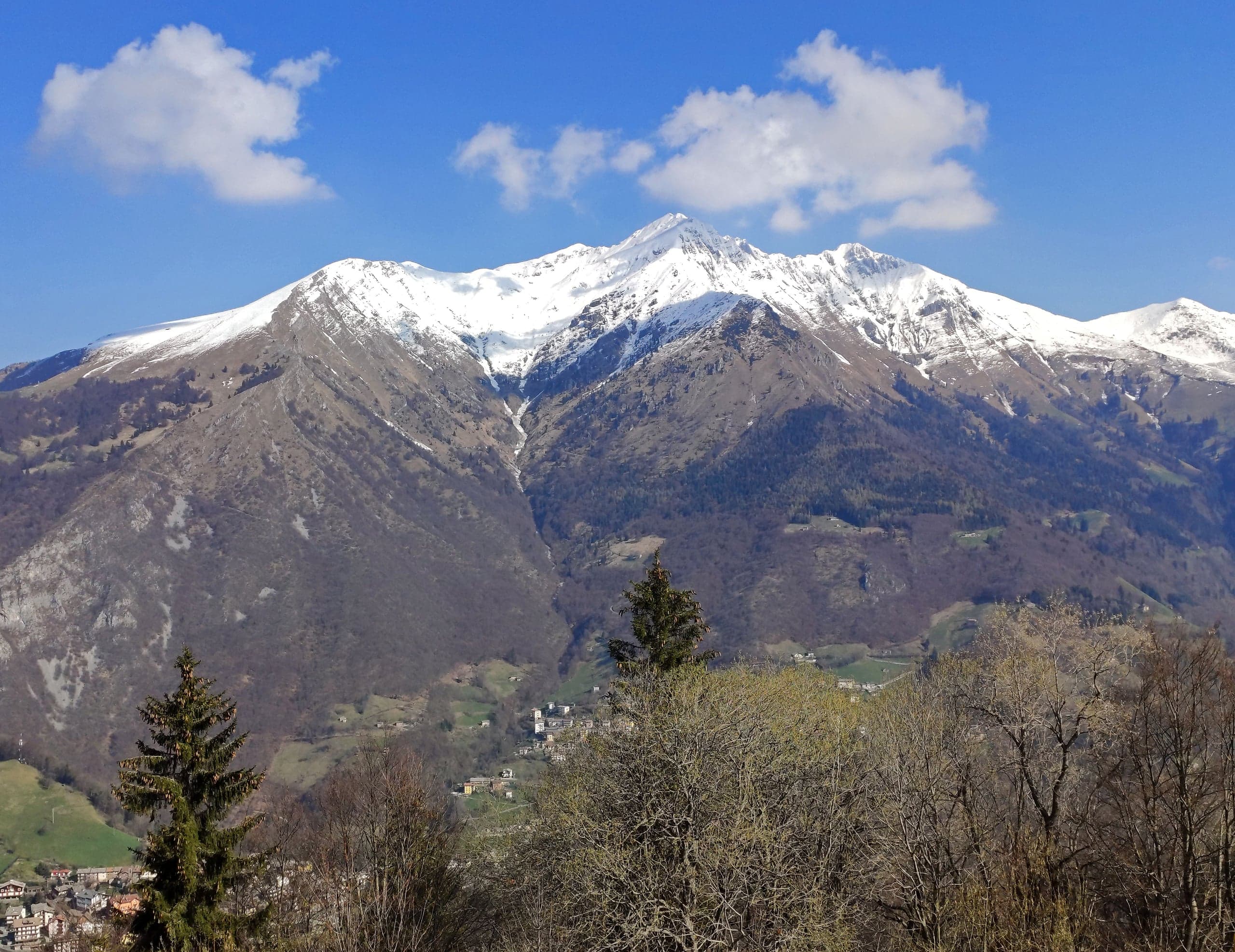
Cima di Menna (2,300 m) from Zorzone
Cima di Menna, 2,300 m, from Zorzone on CAI trail 234: 1,250 m and 4 hours up through Val Carnera and the MAGA bivouac, with no water along the way.
Hikes · 2 minutes
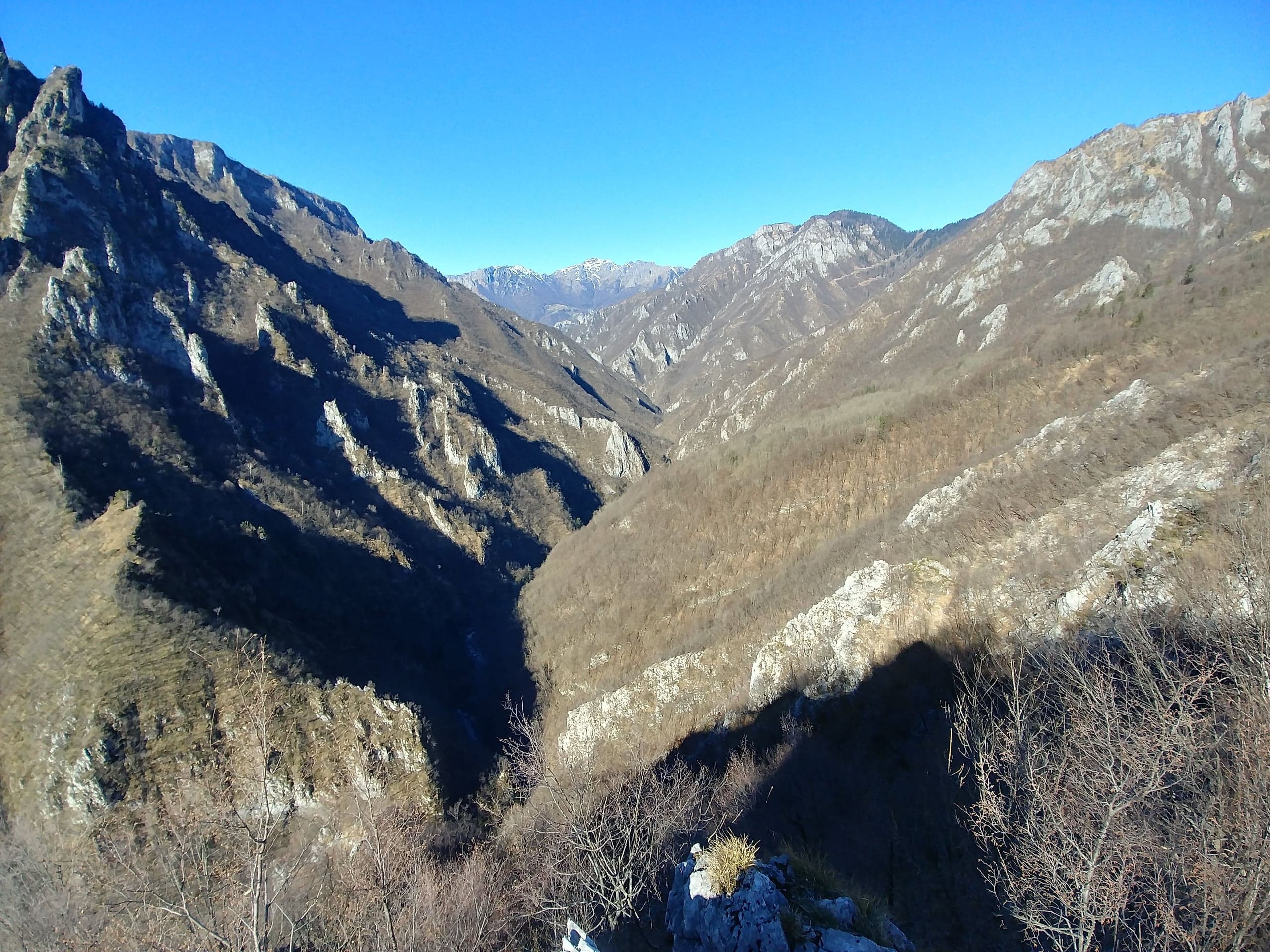
Val Parina: the traverse from Zorzone to Scalvino on CAI trail 259
Val Parina, Zorzone to Scalvino on CAI trail 259: 12 km and 450 m of descent through gorges, chained ledges and the rails of an old timber and marble line.
Museums · 2 minutes
Museum of Minerals and Mining in Zorzone
Three floors on the zinc and lead mines of Oltre il Colle in Zorzone's old school: miners' tools, a rebuilt tunnel, local minerals and a 1944 memorial.
Churches · 1 minute
Church of the Santissima Trinità in Zorzone
Zorzone's parish church, a parish since 1636, rebuilt between 1745 and 1755 to a design by Giovan Battista Caniana: dome, stucco work and a canvas of 1628.